
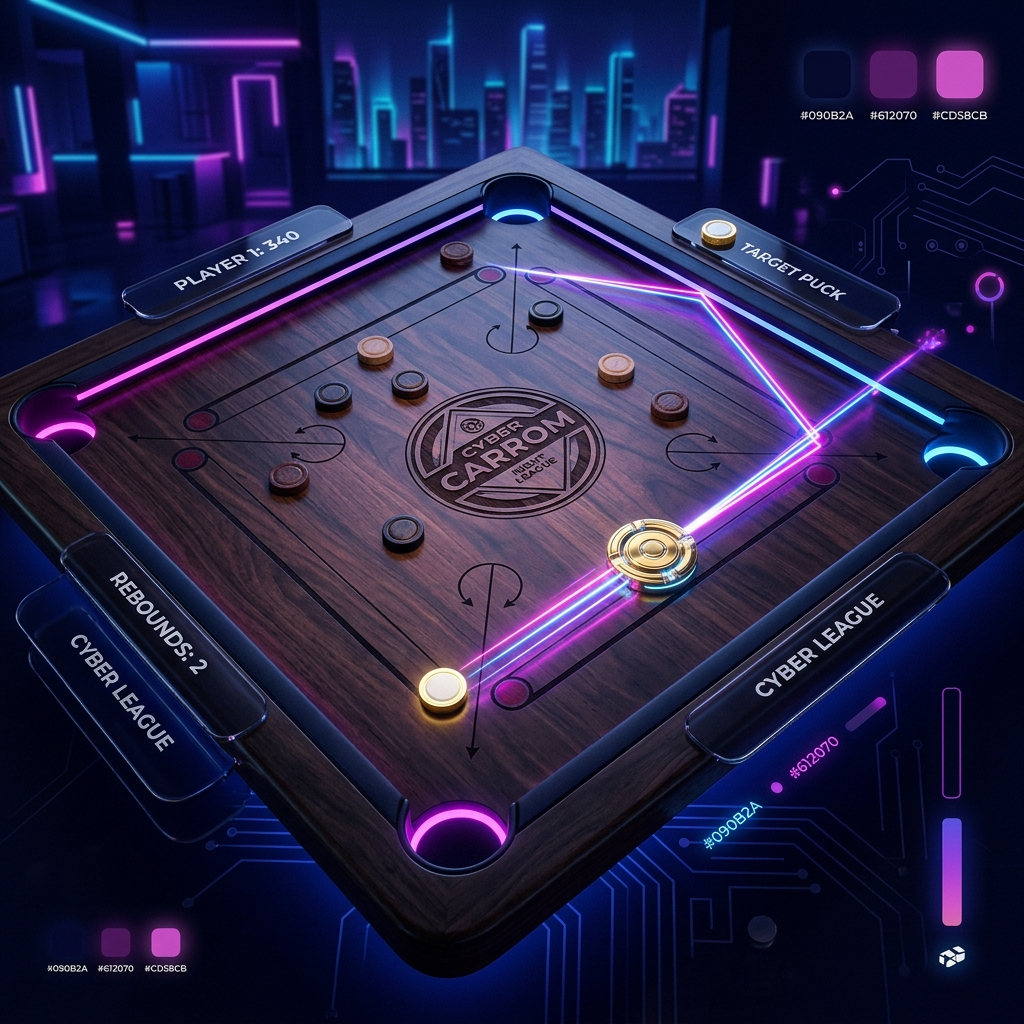
Every match in Carrom Pool is decided by a handful of critical moments — a precise cut into the far pocket, a rebound that threads between two blockers, or a lucky shot that lands exactly where you need it. The difference between players who win consistently and those who don't isn't talent. It's technique.
This guide breaks down every trick shot worth learning in Carrom Pool, from foundational shots that beginners need to advanced techniques that experienced players use to clear boards in a single turn. We also cover the lucky shot and lucky box system in detail — something most guides skip entirely — along with mode-specific strategies for Carrom, Disc Pool, and Freestyle.
Essential Shot Types Every Player Must Know
Before attempting advanced carrom pool trick shots, you need a solid foundation. These five core shots form the basis of every strategy, every break, and every comeback.
The Straight Shot
The most fundamental shot in the game. Line up the striker directly behind the target puck with a clear path to the pocket. No angles, no rebounds — just a clean, direct strike.
When to use it:
- Pucks sitting directly in line with a pocket
- Early-game opportunities after a clean break
- Covering the queen when you need a guaranteed pocket
Tip: Resist the urge to add power. A gentle, controlled straight shot pockets more consistently than a hard strike that risks the puck bouncing off the pocket lip.
The Cut Shot
The most important shot to master in Carrom Pool. A cut shot strikes the edge of a puck at an angle, sending it diagonally into a pocket that isn't aligned with the striker's path.
How it works:
- Position the striker so it contacts only one side of the puck
- The thinner the contact, the sharper the angle
- The puck travels roughly perpendicular to the point of contact
Why it matters: Most pucks on the board won't be directly in line with a pocket. Cut shots let you pocket them anyway. Players who master cuts can score from almost any board position.
The Rebound (Bank) Shot
When a direct path to the puck is blocked, use the board's cushion to redirect the striker. The striker bounces off the rail and hits the target puck from an unexpected angle.
Key principles:
- The angle of incidence equals the angle of reflection — the striker leaves the cushion at the same angle it arrived
- Use moderate power; too much force causes unpredictable rebounds
- Aim for the cushion point that creates the correct bounce angle toward your target
Rebound shots are essential for reaching pucks trapped behind clusters or positioned along the far rail.
The Double Shot
A double shot uses the board's edge to pocket a puck indirectly. The striker hits the puck, the puck travels to the opposite cushion, bounces back, and drops into a nearby pocket.
Best situations for double shots:
- Pucks near the center of the board with no direct pocket line
- Pucks positioned along the rail where a straight shot would push them past the pocket
- When you want the striker to stay in the center for your next turn
This is one of the most satisfying carrom pool trick shots to execute and a reliable scoring option once you understand the rebound geometry.
The Indirect Shot
An indirect shot is any shot where the striker contacts one puck, which then hits a second puck into a pocket. Think of it like a billiards combination shot.
When to use it:
- Your target puck is blocked, but another puck is between the striker and the target
- Two pucks are touching or nearly touching — striking the first can redirect the second
- You want to pocket a puck while simultaneously repositioning another
Indirect shots require reading the board carefully and predicting how energy transfers between pucks on contact. They are high-reward plays that experienced players use to maintain long scoring runs.
Advanced Carrom Pool Trick Shots
Once the fundamentals are second nature, these advanced techniques open up scoring opportunities that most opponents won't see coming.
The Back Shot
One of the trickiest shots in carrom. When a puck sits near your own baseline — behind the striker's starting position — you can't aim backward directly. Instead, strike the striker hard toward the opposite end of the board. It rebounds off the far cushion, travels back across the full board, and pockets the puck near your baseline.
Execution tips:
- Use near-maximum power — the striker needs to travel the full board length twice
- Aim slightly off-center to account for the puck's position relative to the pocket
- Practice this shot in offline mode before attempting it in ranked matches
The back shot is rare, dramatic, and extremely effective when your opponent thinks that puck is safe.
The Board Shot (Triple Cushion)
The most advanced rebound technique. The striker contacts three separate cushions before hitting the target puck. This shot is used when:
- The puck is in a position unreachable by single or double rebounds
- You need to navigate around multiple blocking pucks
- You want to demonstrate complete board control
Board shots require precise angle calculation and consistent power control. Even small errors compound across three cushion contacts, so accuracy is critical.
The Third Pocket Shot
A deceptive play where you send a puck into an unexpected pocket — not the obvious nearest one, but a pocket on the opposite side of the board. This confuses opponents in competitive matches and prevents them from predicting your patterns.
Strategic value: If your opponent notices you always pocket toward the same two corners, they'll position their pucks to block those pockets. The third pocket shot breaks their defensive positioning.
The Alley-Oop (Setup Shot)
Instead of pocketing a puck immediately, you position it right next to a pocket — setting up an easy shot for your next turn. This is especially valuable in four-player matches where your partner can pocket it on their turn.
When to use it:
- The puck can't be pocketed cleanly from the current angle
- You want to guarantee a score on your next turn rather than risk a miss now
- In doubles, your partner has a better angle to the pocket
The Cluster Break
When multiple pucks are grouped together in the center or along a rail, a controlled cluster break scatters them into pocketable positions. The key is using just enough force to separate the pucks without sending them to random positions.
Technique:
- Aim for the edge of the cluster, not the center — a center hit creates chaos, an edge hit creates separation
- Use 60–70% power — enough to spread the pucks, controlled enough to keep them near pockets
- Plan which direction each puck will travel before you strike
A well-executed cluster break can set up two or three easy follow-up shots.
The Striker Shot (Power Flick)
A striker shot uses maximum power and precise aim to drive the striker through a puck so forcefully that the puck crosses the entire board and sinks into the opposite pocket. This shot only works with upgraded strikers that have high power stats.
Requirements:
- A high-power striker (Epic or Legendary tier)
- A clear path between the puck and the far pocket
- Confidence — hesitation kills power shots
Lucky Shot & Lucky Box: Complete Guide
The lucky shot is one of Carrom Pool's most rewarding features, yet most guides barely mention it. Understanding how it works — and how to maximize your rewards — can significantly accelerate your progression.
What Is the Lucky Shot?
The lucky shot is a daily bonus mechanic that gives you a free shot at a special board. A single puck sits on the board surrounded by zones marked with different prizes — coins, gems, striker upgrades, and puck collections. You flick the striker to land the puck in the highest-value zone possible.
How to access it:
- The lucky shot refreshes every 24 hours
- Open the game and look for the lucky shot icon on the main screen
- You get one free attempt per day; additional attempts may cost gems
Lucky Shot Tips for Better Rewards
While luck plays a role, shot technique matters:
- Aim for the center zones — these typically hold the highest-value rewards (gems, rare strikers)
- Use light power — gentle shots give you more control over where the puck stops
- Watch the puck's trajectory — after a few days, you'll notice how the prize zones rotate and can plan your aim accordingly
What Is the Lucky Box?
The lucky box (also called the golden lucky box) is a reward chest that appears periodically during gameplay. Opening it grants randomized prizes — coins, gems, stickers, or puck sets.
How lucky boxes appear:
- After winning matches
- Through daily login rewards
- As milestone prizes during seasonal events
- Sometimes offered after watching a short video
Golden Lucky Box Trick
The golden lucky box contains higher-tier rewards than standard lucky boxes. To maximize your chances of receiving one:
- Play during active events — seasonal and limited-time events increase golden lucky box drop rates
- Maintain win streaks — consecutive victories improve reward quality
- Check the lucky box section daily — today's carrom pool lucky box rewards refresh regularly, and logging in consistently ensures you don't miss rare drops
- Open chests promptly — don't let chest slots fill up; keeping open slots increases the rate at which new chests appear
Jackpot Trick
The jackpot in Carrom Pool's lucky shot system is the highest possible reward tier. Landing the puck precisely in the jackpot zone requires:
- Near-perfect aim toward the smallest target zone
- Very gentle power — just enough to reach the zone without overshooting
- Patience — the jackpot won't hit every day, but consistent attempts improve your feel for the right power level
There is no guaranteed hack or exploit for the lucky shot or lucky box — the system uses randomized reward tables. However, disciplined daily play and careful shot technique increase your overall return over time.
Break-to-Finish Strategies
Clearing the entire board in a single turn is the ultimate display of skill in Carrom Pool. It requires a strong opening break, accurate follow-up shots, and forward planning for every puck on the board.
Strategy 1: The Controlled Break
Instead of smashing the opening cluster with full power, use 60–70% force aimed slightly off-center. This separates pucks into predictable positions near the pockets rather than scattering them randomly across the board.
A controlled break creates two or three immediate scoring opportunities and leaves the remaining pucks in positions you can plan around.
Strategy 2: Pocket the Edges First
After the break, prioritize pucks that are close to pockets or along the rails. These are the easiest to pocket and build momentum for the trickier shots later. Leaving them for later risks your opponent pocketing them first if you miss a turn.
Strategy 3: Work the Queen Mid-Board
Attempt the queen pocket once you've cleared three or four pucks and the board is more open. Trying the queen too early — with a crowded board — increases the risk of missing the cover shot. Trying it too late leaves you exposed if you fail to cover.
Ideal queen timing: After clearing roughly half your pucks, with at least one easy cover shot available near a pocket.
Strategy 4: Keep the Striker Central
After every shot, think about where the striker will come to rest. Ideally, it should stop near the center of your baseline — giving you the widest range of angles for your next shot. Shots that leave the striker in a corner limit your options dramatically.
Strategy 5: Plan Two Shots Ahead
Before every strike, identify not just the puck you're targeting but also the puck you'll target next. Ask yourself: After this shot, where will the striker be, and what angle will I have to the next puck?
This forward-thinking approach is what separates break-to-finish players from those who pocket three or four and then lose control.
Strategy 6: Save One Easy Shot
Always keep one straightforward pocket in reserve — a puck sitting right next to a pocket that you can use as a safety net. If a difficult shot goes wrong and you lose control of the board, having an easy shot waiting helps you recover momentum.
Mode-Specific Tricks
Each game mode in Carrom Pool rewards slightly different techniques. Adapting your trick shot selection to the mode you're playing improves your win rate.
Carrom Mode Tricks
- Queen-first break: In Carrom Mode, some players aim the opening break to send the queen toward a pocket immediately. If successful and covered, this gives you an early points advantage.
- Defensive blocking: If you can't pocket a puck, place the striker so it pushes an opponent's puck away from their target pocket.
- Double-pocket sequences: Plan shots where pocketing one puck sends another toward a pocket, creating chain reactions.
Disc Pool Mode Tricks
- Speed matters: With only five pucks per player, Disc Pool matches end quickly. Prioritize fast, high-percentage shots over complex trick shots.
- Rail control: In Disc Pool, pucks along the rail are harder to pocket. Use rebound shots early to clear them before they become obstacles.
- No queen pressure: Without a queen to worry about, you can focus entirely on pocketing speed and striker positioning.
Freestyle Mode Tricks
- Rapid-fire aiming: Both players shoot simultaneously in Freestyle. Speed is as important as accuracy — practice quick aim-and-release patterns in offline mode.
- Claim pockets early: In Freestyle's chaotic environment, pocket any available puck immediately. Waiting for the perfect shot means your opponent takes it first.
- Power over finesse: Freestyle rewards aggressive play. Use higher power to pocket pucks quickly before the board state changes unpredictably.
Tips for Improving Accuracy and Consistency
Trick shots only work if your fundamentals are solid. These tips address the core skills that make every shot — basic or advanced — more reliable.
Control Your Power
The single most common mistake in Carrom Pool is using too much force. Excessive power causes:
- Pucks bouncing off pocket lips instead of dropping in
- The striker flying off the board (foul — turn lost)
- Unpredictable puck positioning for follow-up shots
Rule of thumb: Use the minimum power needed to reach the pocket. A puck that barely drops in is just as scored as one that rockets in.
Use the Aiming Guideline
The guideline shows the striker's projected path. Higher-level strikers extend this guideline further, giving you more information per shot. Always:
- Align the guideline with your target before adjusting power
- Account for the guideline ending — the puck continues beyond the guideline's visible length
- Use the guideline to judge rebound angles off cushions
Upgrade Your Striker Strategically
Striker stats directly affect your trick shot ability:
| Stat | Impact on Trick Shots |
|---|---|
| Aim | Longer guideline → better angle planning for cuts and rebounds |
| Power | Higher max force → enables back shots and cross-board strikes |
| Time | Longer turn timer → more time to plan complex trick shots |
Prioritize Aim first. A longer guideline improves every shot type, while Power and Time are situational.
Practice Offline Before Going Online
Offline mode against AI is the best place to practice trick shots. There's no pressure, no coin loss, and no timer stress. Spend 15–20 minutes per day practicing:
- Cut shots from different board positions
- Rebound angles off each cushion
- Cluster breaks with controlled power
- Back shots and triple-cushion attempts
Muscle memory built offline translates directly to online performance.